Everyone should have a chance to live in another country. I'm an American who's lived in five countries and am currently living in France with my lovely French wife. This blog is about finding opportunities abroad and the challenges you'll face.
Regarding exactly what type of mood disorder is involved, the article has this tidbit:
... the statement noted that information about Jackson’s treatment is protected under federal law by the Health Insurance Portability and Accountability Act, or HIPPA (sic).
I think that everyone has a right to privacy regarding their health issues. It's troublesome when your elected representative has a mental health issue requiring treatment but that appears to be pretty rare (notice how I'm not even going after the low-hanging humor fruit).
The protection of your health insurance should you change your job
The privacy of your health information.
In fact, your privacy under this act is so sacrosanct that the US Department of Health and Human Services HIPAA portal focuses on privacy first, and portability later. They even have privacy in the URL! It's serious business, folks.
If you're an expat, there's a good chance you'll smell a whiff of hypocrisy here.
For those who haven't been following along here's what's going on.
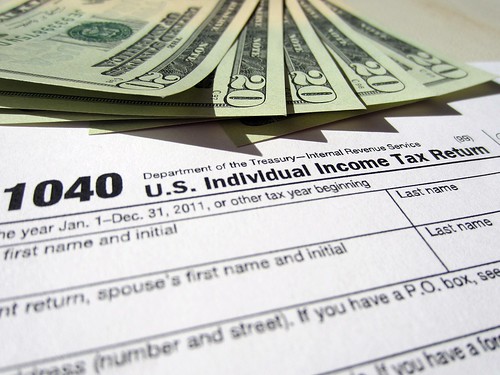
If you move from California to New York, you may have failed to notice something that didn't happen. Specifically, California does not come after you for income taxes for the rest of your life. Why not? Well, why are taxes collected? Taxes are collected to offset the costs the government incurs for providing you services. If you're forced to pay money to a government and receive nothing in return, this is called paying tribute, not paying taxes. In my case, I've lived in Texas, Louisiana, Washington (state), Oregon, Hawaii and Alaska. If all of those states were to chase after me for taxes, I'd go bankrupt just paying for the tax preparation, not to mention the taxes.
I have also lived in Japan, the UK, the Netherlands and now France. Can you imagine if I had to pay taxes to five countries and six US states? This would completely shut down large portions of the world economy as people would be incapable of leaving their home countries and multinational businesses would suffer greatly.
This is why countries tax people resident in their countries. Residents receive the services, expats do not. Except that there are two countries that do tax their expats: the dictatorship of Eritrea and the United States.
Except that even with the USA, there's an interesting problem: we expats were never told of this. In fact, it wasn't until the last issuance of our passports that there was even a mention (in small print at the back) that we were liable for them. Having lived abroad for years, I've been in US consulates several times and I was never told of this legal obligation, nor had I ever seen notices to this effect. Surveys that I've read and numerous news articles reinforce this point: We simply had no idea that, with the exception of the Eritrea, the US is the only nation that taxes their citizens abroad (actually, they try to tax foreign nationals too, but that's another post).
Lately there's been a lot of talk about taxation and many expats are finally learning that they're subject to them. Fortunately, I already knew about this and I file my taxes with Expatriate Tax Returns, but not everyone has been so lucky as to know about the issue.
Please note that I am not a lawyer or accountant, so do not consider any of the following to be legal advice!
That's where the IRS "reprieve" comes in. Basically, if you didn't know about your tax obligations, you can "come clean" if you file your past three years of taxes and past six years of missing FBARs (Foreign Bank Account Reporting). From the IRS publication:
While more details will be forthcoming, taxpayers utilizing the new procedure will be required to file delinquent tax returns, with appropriate related information returns, for the past three years and to file delinquent FBARs for the past six years. All submissions will be reviewed, but, as discussed below, the intensity of review will vary according to the level of compliance risk presented by the submission. For those taxpayers presenting low compliance risk, the review will be expedited and the IRS will not assert penalties or pursue follow-up actions. Submissions that present higher compliance risk are not eligible for the procedure and will be subject to a more thorough review and possibly a full examination, which in some cases may include more than three years, in a manner similar to opting out of the Offshore Voluntary Disclosure Program.
To qualify as low risk, if you owed $1,500 or less for each of the three years, you should be fine. Except ... (emphasis mine):
In general, the risk level will rise as the income and assets of the taxpayer rise, if there are indications of sophisticated tax planning or avoidance, or if there is material economic activity in the United States. Additional risk factors include any additional history of noncompliance with United States tax law and the amount and type of United States source income. Additional information regarding the specific factors the IRS will use to assess the level of compliance risk, and how information regarding those factors should be presented in the submission, will be released prior to the effective date of the new procedure.
Hello! Thank you for being vague. What is "sophisticated tax planning"? And what does "the amount and type of US source income" mean? This procedure goes into effect September 1st, so if you're delinquent on your taxes, you've probably already missed the deadline for this year (unless you have an approved extension), so do not file your taxes before September 1st! (Again, contact a lawyer or tax preparer first! Do not trust my advice).
I am rather delighted that I have now turned in the final edits for my book and the proofs are starting to come back. This means that, for the first time in almost a year, I have free time (how the hell did I keep this blog going?)
So what do I do with my free time? I write software, of course. And I'm using it to track you. No, that's not quite true. I'm using it to track people who have renounced their citizenship under section 6039G of the HIPAA act (damn, I've memorized that now). They're reported in the Federal Register and I've download their data and am slowing beating said data into shape. Here's a sample record (listed here because it's well known that Eduardo Saverin renounced his US citizenship):
The basic process works like this:
I add the records for all renunciants per quarter.
I run code that does a heuristic check to find out if the person is "newsworthy".
I refuse to share this data.
Much of this turns out to be an extremely tedious process because the renunciation data isn't structured very well. I'm not going to say exactly how I did this because I don't want to violate people's privacy. If you want to duplicate this, you'll have to start from scratch. As a result, this software and the offsite backups are probably not going to be made public.
So why am I doing this? My intent is to slowly compile a list of expatriates whose voices might be powerful enough to have an impact on the expat debate. I want to try to contact them and confirm their identity. If they agree, I want to interview them and post that here. If they ask for privacy, I will respect that (in fact, I've already started building that into the software). I don't want to cause anyone grief, so no one will be "outed" without their consent. I've already kept quite about one name because the person asked me to.
I have to say that reading through the list of potentially newsworthy expatriates is fascinating. There are some names showing up that have surprised the hell out of me once I started reading about who these people might be, but my heuristic checks are pretty spotty since all I have is a name to go on. There aren't going to be too many false negatives, but there are a lot of false positives. Frankly, I love hacking on data (that's probably why I'm a computer programmer) and this is just fascinating as hell.
About seven months ago I wrote a post entitled No Republicans in Europe? and wondered why I couldn't find Republicans here. It's not to say that there aren't any Republicans abroad, it's that I generally couldn't find many who weren't over here on a work assignment. A Republican who moves abroad to discover the world is a rare creature indeed. I've met two (that I know of) in six years in Europe.
As it turns out, the groups Republicans Abroad (RA) and Democrats Abroad (DA) are both on Facebook. Apparently, RA was on there almost a year before the DA page. As of this writing, RA has 316 likes with 17 "talking about this" and DA has 14,619 likes with 2,680 "talking about this". While hardly scientific, the Democrats Abroad group which started later than the Republicans Abroad group has almost 50 times as many members. The DA page is active with lively discussion. The RA page has tumbleweeds.
More to the point, an early post to the RA Facebook page has this interesting post:
No, I am not surprised.
I've actually wondered if Republicans Abroad really exists or if it's just a front organization trying to make the Republicans not look like a bunch of head-in-the-sand isolationists. Here's the Democrats Abroad sign up page. I am not a Democrat, but I joined anyway. The email is sometimes interesting and often useful (particularly when I am alerted to some new tax punishment the US is handing down to expats). The sign up process is simply filling out a form and clicking submit. It's quick, easy, and free.
Is this thing a joke? The minimum you can pay is $50? And what's that for? A month? A year? Lifetime? And you have to print out the form and mail it? This is positively hostile to getting people to sign up. That might be the point.
I see there's a small amount of activity on the French RA page and I wish I could have attended that dinner they mentioned. It would be interesting to find out if Republicans in Europe are anti-science and global warming deniers as their counterparts back in the US.
Today's guest post is from Kelly Dunning. She contacted me a while ago about writing one and this sounded like a great way to capture the spirit of adventure that many expats share. If you make up your mind to go, this could be you.
Adventures in Accrington: How I Accidentally Ended Up Working Abroad in Northern England
What do you say when the sexy and confident Englishman that you met only a few months before while travelling New Zealand asks you to come back to the UK and live with him?
Kelly and Lee on a Jeep safari in Portugal
If you are me, you say, “why the hell not?” and end up on an unexpected 14 month detour to the small Northern town of Accrington, Lancashire.
In the autumn of 2009 I left my home country of Canada to spend six months working and travelling abroad in New Zealand. I had no idea that it would be nearly two years until I set foot on Canadian soil and that my adventures would take many twists and turns along the way.
The first twist in the story is when I laid eyes on Lee.
I got a job in New Zealand as a tour guide at Napier Prison, which was the oldest prison in the country and a popular tourist attraction on the east coast of the North Island. The site hasn’t been a prison for decades and it now hosts backpackers and offers tours of the historic jail cells.
When I arrived as a young and bewildered traveler one September evening and walked into the staff lounge, Lee was sitting on a table dressed in a prison jumpsuit and covered in ghoulish makeup and fake blood in preparation for a scary night tour event. Despite this somewhat creepy first impression, I was immediately fascinated by his rough Lancashire accent, his irreverent demeanor and his completely disarming confidence.
Over the next month we both started seeking each other out to spend time together, eating at Burger Fuel, swimming at the Ocean Spa and taking walks together in the Botanic Gardens. Then, our travels took us in different directions for six weeks although we kept in contact with one another.
Kelly and Lee hiking in Alberta, Canada
The second twist in the story came in December, when we both ended up in Christchurch at the same time. We both wanted to get jobs and rent an apartment and for a couple of months and decided to share a place to save money, which is how we ended up living together before we were even officially a couple!
After a few months of working, living and partying in Christchurch, Lee had to go back to England. Neither of us had discussed whether our travel romance could turn into a long term thing, but we both knew that we were on to something good. When he suggested that I apply for a working holiday visa to the UK and come with him I knew that if I didn’t, I would have always wondered how it would have turned out.
It turns out that saying “yes” was the best decision that I have ever made. I ended up spending 14 months living in Lee’s hometown of Accrington eating steak and kidney pie, watching football matches and taking care of cute little kids at a daycare (or nursery as they call it over there.) The visa was very easy to obtain and it allowed me to work in England for 12 months. I fell in love with the UK; the history, the culture and the gorgeous architecture and countryside. I made lots of great friends and felt like I was accepted as part of the community.
During our time in England, Lee and I decided that what we really wanted to do was to travel the world together, so I started to build up an income as a freelance writer, a job that I could do from anywhere in the world. It took a lot of hard work, but we soon were able to travel from the money that I could pull in while working on the road. We cut down our possessions to only what we could carry on our backs and we set out for adventure.
Since then, we have relaxed in the Algarve region of Portugal, stuffed ourselves with pasta in Rome, backpacked our way across Canada, survived a winter in Newfoundland, stayed with a New Yorker in Brooklyn, visited Lee’s brother in Virginia, listened to Jazz in New Orleans, and toured the monuments in Washington. As I write this, we are in Bangkok, Thailand on a new quest to see the wonders of Southeast Asia.
My experience taught me to be open to what life throws at you. I could have said “No” when Lee asked me if I wanted to apply for a working holiday visa and come back with him to England. It was a risk and there were many ways that it could have gone wrong. However, it was worth taking the risk because everything worked out even better than I could have imagined. Not only did I have a wonderful experience working abroad in the UK, now we are fulfilling our dreams of traveling the world!
Living and working abroad involves taking a lot of risks and requires you to leave the familiar behind and leap towards new possibilities. When you go abroad, don’t be afraid to let your heart make a few important decisions as you just might love where it leads you. Author Bio
Kelly Dunning is a writer for Global Visas, the world’s leading authority on immigration and your best source for UK working holiday visas. She is also a coffee-lover, very bad singer and international pub quiz winner. She wrote this guest post from an open air café in the heart of bustling Bangkok with the buzz of tuk-tuk engines and the smell of frying noodles in the air.
On a plaque affixed to the front of a boy's school in Paris I walk past every day:
The plaque reads:
A la mémoire des élèves de cette école déportés de 1942 a 1944 parce qu'ils étaient nés juifs. Victimes innocentes de la barbarie nazie avec la complicite active du gouvernement de Vichy.
Ils furent exterminés dans les camps de la mort.
And in English:
To the memory of the students of this school deported from 1942 to 1944 because they were born Jewish. Innocent victims of Nazi barbarism with the active complicity of the Vichy government.
They were killed in death camps.
We constantly see these reminders of the horrors of war. I wonder how the US would be different if it had experienced these horrors on her own soil and had these reminders everywhere?
I'm not kidding. Nor do I mean this in the sense of those pedants who correct you when you refer to the US as a democracy by replying loftily that "the US is actually a republic."¹
Not much voter choice in the USA
Consider the US Congress. According to the US Census Bureau, since 1975 the US Congress has never had more than two members who were not a Republican or Democrat. For four of those years, Congress only had Republicans and Democrats. With 535 politicians controlling legislation for the entire United States — and impacting the rest of the world, to boot — it's worth wondering if never having third parties representing more than one half of one percent of said politicians is truly representative of Americans?
With more than two-thirds of Americans say they would vote for a "third party" candidate (and half saying a third party is needed), it's interesting to note that the term "third party" seems to imply that there should be a fixed number of parties rather than "parties should exist to reflect the will of the people." Many people in American would vote Green, Socialist, or Libertarian if they had the choice (many Libertarians run as Republicans, though), but doing so is seen as throwing away your vote because your candidate can't win.
The US political system is due in part to something called Duverger's Law which asserts that a "winner-take-all" electoral system like that of the United States tends towards two-party systems. This tends to lead to low voter turnouts and interesting issues where Bush, in 2000, became President even though only one quarter of the eligible voters voted for him (and, of course, the electoral college allowed him to win even though he lost the popular vote, and that's ignoring the Supreme Court issues).
To understand more about why third parties cannot succeed in the United States, you can read this excerpt from the book Third Parties in America. In particular, I point you to this interesting point about even getting your name on a ballot:
The Democrats and Republicans have constructed a maze of cumbersome regulations and procedures that make it difficult for minor parties and independent candidates to gain a spot on the general election ballot. Whereas major party candidates automatically appear on the ballot, third parties must petition state election officials to be listed. A candidate whose name does not appear is obviously disadvantaged: voters are not cued when they enter the polling booth; it is difficult and at times embarrassing for a voter to cast a write-in ballot.
Ballot access was not a problem for third parties in the nineteenth century, because there were no ballots as we now know them. Prior to about 1890, the political parties, not the states, prepared and distributed election ballots (or "tickets," as they were called), listing only their own candidates. Party workers peddled their ballots, usually of a distinct color and shape, at polling stations on election day.
This undermines the argument that the US has had successful third parties in the past and therefore can do so again: the Republicans and Democrats are quite happy to ensure that they are the only game in town.
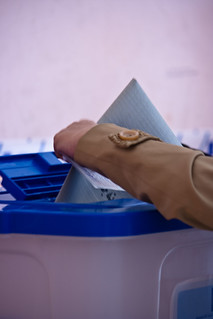
It should be clear that in the United States, where the game is clearly rigged against third-party candidates, it's hard to truly claim to be a democracy if you think of a government where the will of the people can be exercised by voting. Americans regularly mock single-party "democracies", but as one Brian Wisti points out, the US has a 1.5 party system. Though my view is somewhat unpopular, I view Republicans as on their knees, fumbling at the zippers of major corporations whereas the Democrats meekly ask that the door be closed first.
Perhaps most telling of all is President Obama, despite admirable intentions of trying to stop some of the worst excesses that happened under the Bush administration, found his hands tied by even the Democrats refusing to support him because they wanted to be re-elected and couldn't come across as being "soft on terror".
Not perfect, but France has plenty of voter choice
France is different. Though not having proportional representation (the voting system that I think best represents the will of the voters — both good and bad, but that's a democracy!), France uses two-round voting. In this system, you vote for any candidate you like in the first round, secure in the knowledge that you're unlikely to be throwing away your vote. If no candidate wins an outright majority, a second "runoff" round of voting is held where you vote for the top two candidates. The system is not perfect and France also has two major parties, the Socialists (who are still in favor of capitalism) and the Union for a Popular Movement (the UMP), a center-right party. However, they also have the New Centre, the Communist Party, the Radical Party, the Radical Party of the Left, the Green Party, the Democratic Movement and many others.
Due to the two-round voting system, the French government usually forms a coalition government whereby minority viewpoints actually get represented. It's far from perfect and yes, like a proper democracy, groups that you don't like actually get to be heard, but at least there is choice. Now compare that to a campaign ad from the last major third-party Presidential candidate to be given serious consideration in the US:
So all you have to do is get a million dollars, set up a dummy corporation, give the money to the corporation who in turn gives it to an "independent" political organization. Then you dissolve your dummy corporation. Were you to give your money directly to the political organization, it would then be a crime.
It's expected that the Romney-Obama battle will cost about one billion dollars. In a recent Time Magazine article describing France's recent Presidential election, they revealed that the top two French Presidential candidates spent $54 million between the two of them in 2012. There are no SuperPAC's, corporations and unions are forbidden to fund their desired candidates, and spending your way into power is much harder. From the article:
For better and worse, France puts égalité in politics before the liberté of candidates to invest big bucks in mass marketing displays of what little fraternité they feel for one another. Indeed, flesh-flaying attack ads frequent in U.S. elections are illegal under French rules. Not only is buying French airspace for political commercials forbidden; so is disparaging rivals in any electoral advertising that is allowed. Turning a campaign around with an effective but expensive Willie Horton, Swift Boat, or Morning In America adjust isn’t an option in France.
Presidential candidates must get 500 mayors in France to support their candidacy and, if they do, they get the same amount of space to advertise publicly, same amount of free airtime, and strict laws are in place to ensure the media treats them fairly, whether they are the front runner or a guaranteed loser.
And the icing on the cake: on election day, it is a serious crime to report poll results early. No more manipulating those numbers to encourage groups of voters to stay home.
I actually think a lot could be done to improve the French democracy, but so far, it's a damn sight more fair than the US. If I had to characterize the US political system, I would describe it as a plutocracy with a thin varnish of democracy to make it more palatable to voters. There is, quite frankly, not much that is appealing about the current state of the US political system. By traveling the world and seeing it first hand, you get a shocking sense of just how bad things have become.
1. Invariably this "correction" does little to serve the conversation at hand and seems designed solely to impress.