Showing posts with label children. Show all posts

Wednesday, April 3, 2013

UK/US family on verge of being split apart?

Justice
Public domain image
Thanks to a lovely combination of US and UK law, this family is about to be split apart. Their son will be forced to live with one parent or another, in either the US or the UK.

If anyone with knowledge of immigration laws or who has the ear of a politician has any ideas about what they can do to help them, please do so! Spouses shouldn't be torn apart, not their children taken away, just because the governments have the cash register open.

Friday, March 15, 2013

US expat evacuations: not what people think

Saigon Evacuation
We've turned your country into a parking
lot. The least we can do is evacuate you
.
Over on Reddit, I asked people's opinions about why more Americans are planning on leaving the US. As is to be expected, when an expat pointed out that we're taxed by the US government and get nothing in return, there was the silly comment of "I wouldn't say you are paying taxes for nothing. If shit hits the fan in your country the US tax payers usually shell out to get your ass out of the country."

I hear this constantly. It seems like it's the last line of defense for those trying to justify the USA's unique worldwide taxation schema. However, Reddit user prezvdi replied to the above with a stunning response:


Do you have ANY experience to back this statement up?? I'm an American living & working in the UK since 2006. I was in Cairo, Egypt for work when the fun kicked off. I sat in the Cairo Marriott Hotel and watched the UK, the French, the Russian, the Dutch, the Chinese governments arrange for evac of their citizens. My company arranged my "departure" with no governmental assistance. I was safe at home in London when I saw on the BBC that finally the USA was going to send help. So yes, the US government will come to your aid. After nearly every other country on earth. Just hope your hotel isn’t overrun first.
I already knew that other countries often simply go in and rescue their citizens, but I didn't realize quite how bad it is for Americans abroad. After all, I live in France and I don't worry that much about the US needing to fly into Paris and rescue me.

So how does the US handle this situation? If they need to evacuate US citizens abroad, they will charge the full commercial rate. That's a US government document, but let me focus on some key bits:
Who will pay to evacuate me and my family? 
If commercial carriers are operating, the Embassy will recommend that you depart on your own and at your own expense. If you don’t have money to pay the fare, the Embassy can help you contact family and friends and assist in transferring money from them. In extreme circumstances, a destitute American wishing to return to the U.S. may qualify for a repatriation loan. The conditions for making such loans are stringent, and your passport will be limited until you repay the loan.
It goes on to say that if commercial carriers are not operating, the US government will charter aircraft, but still bill you the full commercial rate. While other governments are busy getting their citizens the hell out of danger, the US has the cash register open.

So do they bring you home? No. The FAQ explains: In most cases, the U.S. government will bring Americans to the nearest safe location, which is generally not the United States.

So if you're being evacuated from Pakistan, enjoy your stay in sunny Tadjikistan!

I've been trying to find out the evacuation procedures of other countries with little success. France appears to be quite willing to evacuate their citizens as needed and I can find no mention in French law about charging for said evacuation. The UK might charge for evacuation, but unlike the US, apparently has procedures in place to waive said charges when applicable.

So no, the US tax payers will not "shell out to get [my] ass out of the country." That again leaves me in the curious position of wondering why the US demands payments from expats when it gives nothing in return.

In reading through the US evacuation procedures, I noticed something else curious, but first, a digression.

My wife and I have agreed that if we ever have a second child, it will be by adoption. However, US adoption laws are quite clear about how I can pass on US citizenship to an adopted child:
  1. One parent is a U.S. Citizen by birth or through naturalization; and
  2. The child is under the age of 18; and
  3. The child is residing in the United States as a lawful permanent resident alien (that is to say has entered the U.S. on an immigrant visa and has an alien resident card) and is in the legal and physical custody of the U.S. citizen parent; and
  4. If the child is adopted, the adoption must be final. If the adoption is to be finalized in the United States, the child becomes eligible for citizenship once the adoption process is completed.
Due to point 3 above, our adopted child wouldn't be a US citizen. One of my children would be a US citizen and the other one would not. Under French law, there is absolutely no legal distinction between biological and adopted children. Under US law, adopted children aren't even second-class citizens if they're living overseas! Of course, this isn't the only way that US parents can discover that their children aren't allowed to be US citizens, but it does have one unlikely, but particularly nasty, consequence.

Imagine that we've adopted a second little girl, my family up and moves to somewhere in the Maghreb and a civil war breaks out and I get killed. If the US is evacuating their citizens, according to their evacuation plans (emphasis mine):
If a child does not have an American parent or guardian in-country, the U.S. government will allow one adult to travel with the child on an evacuation flight. If there is more than one American child in the same family, only one adult escort will be permitted. Non-American siblings will not be provided evacuation assistance.
Got that? The US would be kind enough to allow my non-American wife to accompany our French-American daughter, but her sister would have to be left behind. Fortunately, the French would step in and help out, but honestly, does the US really need to be that explicitly cruel? How often does this situation happen that the US has felt the need to explicitly deny non-American siblings of American children the right to be evacuated to safety?

USA: the land of the cold-hearted cash register.

Monday, March 11, 2013

No, Bill Clinton can't run for the French Presidency

No, this man cannot become
the next president of France.
There appears to be a persistent belief that if you live in any of the US states acquired in the Louisiana Purchase, you can quickly acquire French citizenship. This was sparked, in part, by none other than Bill Clinton claiming that he could become President of France. He said:
And because I was born in Arkansas, which is part of the Louisiana Purchase, any person anywhere in the world that was born in a place that ever was part of the French empire, if you move to — if you live in France for six months and speak French, you can run for president.
Bill Clinton said this in 2012, but was unaware that this interesting quirk of French law was eliminated in 2006.

Wednesday, December 5, 2012

Top Ten Expat Myths

Egypt-5B-023 - Approaching Aswan
Nile River, Egypt
Photo by Dennis Jarvis
There's a huge amount of misinformation about expats and expat lifestyle. This list is a bit US-centric, but hopefully it will clear up a few things.
  1. Expats are rich

    If there is any expat myth that I despise, this is the one. Thanks to plenty of articles out there insinuating that we're just a bunch of greedy rich buggers renouncing our citizenship to protect our wealth, there's often a powerfully-expressed hatred about us. We're labeled traitors with more than a tinge of envy coming across in the accusations. In reality, we're teachers, waiters, programmers, husbands, wives, taxi drivers, bankers, construction workers. In short, we're as diverse as you'll find back home and, like you, we're often struggling to make ends meet.
  2. Expats hate America

    Really? I can't find many who do. In fact, in one study of Americans living in Europe (disclaimer: I was a participant in this study), researcher Amanda Klekowski von Koppenfels found that only 4.5% of Americans living abroad cited dissatisfaction with the political system back in the US. Like many Americans, we have a diversity of political views, but unlike most Americans, we get to see first-hand what the rest of the world is like and it turns out that it's quite a bit different from how the US news likes to describe it. For example, the health care "debate" in the US was a joke and even conservative Americans I've met living in Europe acknowledge that things are far better here than what you'd read about in the US media.
  3. You have to have a college degree to move abroad

    Nope. Nope, nope, nope. For most STEM (science, technology, engineering, medicine) fields, yes, you need a college degree ... just as you would if you stayed in the US. However, there are plenty of expats who have traveled the world with only a high school education or a GED. Get a TEFL certificate and teach English. Check out couch surfing. Read about wwoof. Some people just buy a ticket and go (reckless if you don't know what you're getting into).
  4. English is fine

    While I expect this from tourists, I also see this in some expats. Because English has effectively become the world language, people think they can use it everywhere. Now imagine living in Burundi and trying to make an emergency call to a doctor on a Saturday night. Imagine living in Sri Lanka and getting all of your bills in a Sinhala or Tamil. Even if you can get by as a tourist by pointing and miming, living somewhere is a whole different ball game, even in countries where the majority of the population speak English as a second language.
  5. I'll learn the local language

    So you know English isn't enough and are determined to learn the local language. Hah! For some reason, plenty of expats don't bother. Maybe they think they'll be temporary residents. Maybe they just don't care.  Or maybe they just don't try hard enough of find they don't have much time. I have to confess that while I can get by in French, having a full-time job and being a father makes it hard to apply myself to learning French. However, for a country which does not have English as the first language, learning the local language is the best thing you can do to integrate.
  6. It's a dangerous world out there

    Actually, it's not. There's a saying that the news reports the planes that crash and not the planes that land safely. Thus, people who only get their information from watching the news get a very distorted idea of air safety. (Heck, this entire post could be about "how the news gets everything wrong about expats", but that's not always true) The reality is that even in some of the most dangerous places of the world, you're pretty safe (and yes, that largely means Mexico, too. Listen to the news too much and you'll think there are maybe three people left alive in Mexico city, stumbling around and trying to hide).
  7. People in country X are rude/friendly/some other stereotype

    People in the Netherlands have a stereotype of being cold and unfriendly. I can promise you from first-hand experience that this is not true. People in Paris have a reputation for being snobs and refusing to speak English even if they can. In reality, many of them speak broken English and are embarrassed about it. People in the UK have a reputation of drinking 24/7. Well, that one might be true.

    Stop listening to the stereotypes and start paying attention to reality. It turns out that people are, well, people! Yes, there are cultural differences that one can note, but within any given culture there's a huge diversity of people and trying to lump all of them together under one banner is not only silly, it's offensive.
  8. It's like a 24/7 holiday!

    The French have a saying, métro, boulot, dodo. It means "subway, work, sleep". That's how they describe their day to day life. And unless you're one of the vanishingly small number of "rich" expats, that will be your life, too, just as it is back in the US. You'll look forward to having time off to be with friends or to travel a bit, but your life won't magically turn into a fairy tale.
  9. Life is better/worse in country X (I'd never want to live anywhere else!)

    I always want to scream when I hear people I went to school with in Texas say "I'd never want to live anywhere but the good ol' US of A!" All I can think to say is "how would you know?" These are often awesome, intelligent, kind-hearted people who nonetheless have no idea what the rest of the world is like or what it is to live in it. Though I will grant them one thing: if you start with the assumption that you'd hate the rest of the world, it's more likely to be a self-fulfilling prophesy.

    That being said, there are those who are convinced that the grass is greener everywhere but where they are standing. In reality, whether a country is "better" often comes down to two things for most people: their personal value system and whether they've made the effort to build a life there (surprisingly, many expats have not). When that first bout of homesickness kicks in, you may quickly re-evaluate whether or not the grass is greener where you've moved to.
  10. My kids will love it

    This one is dangerous and many expat parents don't treat this problem with the seriousness it deserves. Does your child speak the language of where you're going? Are they old enough that their friends and social structure are more important to them than your need for adventure? It's one thing to take your five year old with you to Chile. It's another thing entirely to take your fifteen year old away from his friends. Particularly by the time your children are entering puberty, think very carefully about this decision and involve them in it!
Being an expat is a wonderful thing and I (obviously) encourage everyone to consider it. There were few things in life more wonderful than sitting on the bank of a Dutch canal, eating bitterballen, drinking Grolsch and debating politics with my Dutch friends. Of course, meeting a lovely woman in London, getting engaged to her in Lisbon and getting married in Tower Bridge would qualify as one of those things.

Friday, November 30, 2012

Raising a bilingual child

My wife and daughter, floating down the Seine in Paris
For parents planning on being expats, raising a bilingual child is often one of the benefits. In today's world, speaking more than one language is often the key to getting that opportunity you wanted. Contrary to what many people think, though, speaking a foreign language probably won't get you a job (plenty of people probably speak whatever language you've bothered to learn), but not speaking that language may be the deal breaker.

But back to children. Quite a number of studies have shown that children who are raised bilingual tend to outperform their peers in school, are better at multi-tasking and being bilingual may help protect against Alheimer's. Expat parents are giving their children an immeasurable gift with multiple languages.

Part of the downside of this is that bilingual children tend to acquire vocabulary later than their peers, largely due to having to split their vocabulary between languages. There is, however, one aspect I notice that others tend not to talk about as much: being the parent of a bilingual child. It's a fact that for many couples, the child is going to be better at speaking the primary language of the other parent. I am that other parent.

Our daughter's first "word", if you will, was "thank you". We have been very careful to be appropriate role models for our daughter and it was very rewarding having her learn to say "thank you" when we would hand her something. She's since mostly forgotten that, but we hope to continue with this.

She also often says "please" if she really wants something (though often with prompting), but this is mostly the extent of her English vocabulary. We live in France and our daughter spends a lot of time with a French child minder, so it's natural that French is going to be the first language. I confess that this makes me a touch nervous. Is my daughter going to learn to speak the language better than I? Well, probably, but I have a some time on this one.

The other day she was running from room to room, chasing after a cat and waving a piece of sausage at it, while yelling tiens, tiens (take, take). It was super adorable. She also recently made her first sentence. When she realized that her mother and I weren't going to get her a pretty ball she saw in the store, she pointed at the ball and said ça moi (that me). That pretty ball is now at home.

I've no idea how well her English will progress. We speak to her in English every evening and many of her books are in English, but we're in France. Her relatives here are all French. She adores watching Petit Ours Brun, a French children's show (each episode is only 3 minutes long. We don't let her watch much). Even though we live in France, somehow it never quite entered my mind that mine would be the minority language.

Update: Ever since I arrived home from work, my wife has been pointing out every English word that our daughter knows. There are quite a few more than I thought!

Monday, August 13, 2012

How babies get denied US citizenship

No, you're not going to believe this story: in vitro babies denied U.S. citizenship. For those not wanting to read the USA Today (and who can blame you?): the US State Department asserts that the US laws requires children to have a "biological link" to at least one parent and in vitro fertilization isn't enough to establish that link. You have to prove that either the sperm or the egg came from an American donor — something pretty damned hard to do when the entire process of donating eggs or sperm is designed to protect the identity of the donor.

You might wonder "what about adopted children"? There's an exception written into the law for them, but if you carry your baby for nine months, give birth, but you're old enough that the consulate is suspicious about how you conceived them, humiliating, invasive questions arise.


Visit NBCNews.com for breaking news, world news, and news about the economy

There's an assertion made in the clip above and in various news stories that US law is not keeping up with technology. I will agree this is true, but in this case, it's about US law pretty much ignoring the reality of our global society. There needs to be a non-partisan, permanent Senate committee representing the interests of the the US population living outside the US. I can't imagine such a thing happening any time soon, despite the fact that we'd be the 18th largest state (by population) if such a thing were to be recognized.

For anyone who thinks that, somehow, against all reason, verifying the citizenship of sperm and egg donors is legitimate, you need to sit down and start asking yourself why we have citizenship laws.

Wednesday, May 30, 2012

The laws are failing expats with children

You had better think about them!
Photo from Wikimedia Commons
Recently I've been looking into acquiring the French Blue Card. This seems strange as my wife is French and I can legally live and work here as long as we're married. We're quite happy together, so why would I want the EU Blue Card? Part of this, frankly, would be for having first-hand knowledge of a process I sometimes write about, but the other part is simply for insurance: if anything were to happen to my wife, I still want to be able to raise our daughter here.

An immigration specialist I spoke with assured me that as a parent of a minor French child, so long as I have been a primary caregiver for at least two years, I have the right to remain in France. Not quite as good as the Blue Card, but much better than being deported back to the US! I'm lucky that in this case, France has looked into this matter and ensured that the right thing is done. Others are no so lucky.

Your author and hisdaughter
in Meaux, France
A Canadian friend of mine living in Amsterdam sent along this horrifying news article : mom can't leave Canada with children, or stay either. In short, an American woman married a Canadian man, but he would never sign the immigration paperwork or sponsor her to remain in Canada. Now that they've separated, she has a restraining order forbidding her from removing the children from Canada, but she has no legal right to remain in the country.

We're transforming from squabbling nation-states into a global society, even if we maintain separate governments and tighten our borders. Our legal frameworks just aren't up to the task of handling our emerging supranational culture. While it's still small, it's growing, but our state-centric legal systems are producing children who have no nationality and people discovering they owe thousands of dollars in taxes to countries they've never lived or worked in. Currently the laws in this area are very much hit or miss and I would love to see the world's governments come together and try to address this issue. With an estimated 200 million people living in countries other than the ones they were born in, it's getting harder and harder to ignore this problem.

Tuesday, February 8, 2011

The Dilemma of our Daughter's Citizenship

A question for parents: imagine for your newborn child you're informed that you have the right to choose a potential of lifetime debt for your child in order to give her some benefits she may never enjoy. Would you do this? Would you do this if you found out that she can choose that lifetime of debt for herself when she's 18? Phrased like this, of course you wouldn't, but it's exactly the dilemma I'm facing now and it's the sort of dilemma parent's should never have to face.

As you no doubt know (assuming you read this blog), I am an American, my wife is French, and our daughter was born Saturday morning here in Amsterdam. Yesterday I registered our daughter's birth with Statsdeel West and our daughter now has an international birth certificate. If we remain in the Netherlands until she's 18, she may choose Dutch citizenship if she wishes. She automatically has French citizenship (via my wife) and I was told I have to register her birth with the US consulate and this registration will automatically give her US citizenship. That's where the problem arises. Update: it turns out that under US law, my daughter is automatically a US citizen. The question is actually whether or not I should register her and alert the US authorities to her existence.

The US is in dubious company here
Photo by http://www.kremlin.ru/
As I've pointed out previously in this blog, the practice of taxing citizens abroad is rare. In fact, it's rare enough that I've yet to see evidence that any country other than the United States does this. I hear conflicting reports of which countries do and do not tax citizens abroad. Aside from the US, the only country which is consistently mentioned is North Korea, but there is never a source. In fact, I cannot find any information linking back to source material to prove which countries do and do not tax citizens abroad. The short list of possible candidates appear to be:
  • North Korea
  • Libya
  • Eritrea
  • The Philippines
  • The former USSR
All things considered, that's a pretty sad list of countries to be in bed with. Not that I expect international tax experts to read this blog, but if anyone can provide any confirmation regarding which countries do and do not tax citizens abroad, I'd be most grateful. The closest authoritative source I've seen is an article from the Economist which states "Along with citizens of North Korea and a few other countries, Americans are taxed based on their citizenship, rather than where they live." Of course, they offer no source, either.

But getting back to the issue at hand, I've been reading quite a bit to find out if IRS international tax requirements apply to my daughter. Given that I can find no exemption whatsoever for my daughter's situation, should I choose her citizenship for her or should I let her choose it when she's 18? I live in Europe now and have no intention of moving back to the US, so that's not an issue while she's living with us, but by the time she's an adult, I've no idea how the law might change.

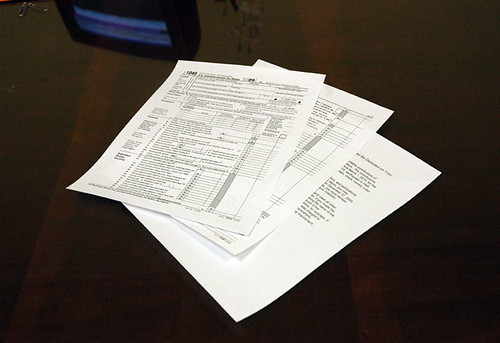
Tax Forms
She didn't ask for this
Photo by KOMUnews
Further, it turns out that the financial exemptions that citizens abroad receive on their US taxes only applies to earned income. Any "unearned" income can be taxed at the full rate, unless the US has a tax treaty with the country she resides in. She may be even be able to escape this by retaining her French citizenship and relinquishing her US citizenship because the US claims the right to potentially tax her for up to 10 years after giving up her citizenship the expatriation tax. As far as I know, the US is the only country which tries to impose income tax on foreigners living in other countries.

For those who think I'm worrying about nothing, not only did I previously mention a UK gentleman I know who discovered that he owes a huge amount of money to the US government because he happens to be a US citizen (apparently his father registered him at the US embassy after he was born, the same situation I'm facing). I'm also discovering that others are finding themselves in the same predicament.

Of course I want my daughter to have US citizenship, but do I really want to burden her with a tax obligation to a country she won't be raised in and may never live or work in?

Tuesday, December 28, 2010

Expats and Children

When I was eight or nine years old my step-father was in the military and was about to be stationed in Germany. My mother asked my sister and myself if we wanted to go and both of us immediately said "no" because we'd miss our friends. Of course, we honestly had no idea what we were being asked and frankly, I think my mother simply asked so that she could have an excuse to tell her husband she wasn't going to Germany with him. Whatever the reason, he went to live in Weisbaden¹, Germany and we stayed. Today I regret saying "no", but I certainly didn't back then.

paris31q
Children won't necessarily
see Paris as "exotic".
Photo by Kika Sso
If you're going to take children to another country, you will have a brand new set of problems to face. I've previously written about the issue of homesickness and how powerful it can be, but it can be even more powerful for children. You'll have to remember that your reasons for moving to a foreign won't necessarily be appreciated by your child. Yes, you may think that it's a "character building" opportunity, but your eight-year old who only speaks English may not have a have a lot of playmates if the local language is Tswana.

You'll also face the problem of education. Many large cities offer international schools for your child's education. My wife and I are considering the International School in Amsterdam for our child, but it's not cheap. Fortunately, we have at least three years before we have to worry about this. Depending on your nationality and circumstances, you may have other options. There is also a new French School in Amsterdam. It's subsidized by the French government and teaches in English and French and introduces children to the Dutch language and culture. Due to the assistance from the French government, it is far less expensive (€8718/year for older children versus about €21,000/year), but still out of the price range for many. So keep this in mind: if your child doesn't fluently speak the native language of your target country, education is going to be a problem.

There is another curious problem that few have to deal with. I'm an American, my wife is French, and our daughter will soon be born here in Amsterdam. What nationality will she be? We're lucky in that we already know that our child will be able to claim US and French citizenship and if we stay in the Netherlands long enough, Dutch as well. However, not everyone is so lucky. There are more and more people living abroad and finding that their children are stateless or claim citizenship in a country which is not the parent's country. What's going on?

Traditionally, there are two routes for citizenship for newborns:  jus soli (right of the soil) and jus sanguinus (right of blood). The former states that you can claim citizenship where you are born. The later allows you to claim citizenship via ancestry (typically your parents). However, politicians are finding that fear of immigration is often a source of cheap votes as it's difficult for immigrants to have a political voice. In the US, for example, you may not have heard of the term anchor baby, but many anti-immigration activists have. The 14th Amendment of the US Constitution guarantees that any child born in the USA is automatically a citizen (jus soli), but not surprisingly some politicians are trying to take this away via HR 1868, the "Birthright Citizenship Act", which would deny citizenship to children unless one of their parents is:
  • a citizen or national of the United States;
  • an alien lawfully admitted for permanent residence in the United States whose residence is in the United States; or
  • an alien performing active service in the armed forces (as defined in section 101 of title 10, United States Code).
Unfortunately, as with most naïve anti-immigration bills, it ignores the modern complexity of the international world and it makes no exception for children whose parents may be stateless or may legitimately be in the US claiming asylum.

To make matters worse, many countries are trying to limit jus sanguinus. By limiting or eliminating both traditional routes for claiming citizenship, more and more people are finding giving birth abroad to be a legal minefield. If you live abroad and are expecting a child, contact your nearest embassy to ensure that you understand the legal implications of the birth.

For my wife and myself, we have a different and somewhat curious issue: what if our child chooses not to take our nationality? This isn't as far-fetched as it sounds. Remember the British gentleman, born and raised in the UK, who was surprised to discover that he owes many thousands of dollars in US income taxes? Our child may well turn 18 and realize that he or she is facing a lifetime of income tax to the US government if US citizenship is accepted. Naturally the French and the Dutch don't tax their overseas citizens.²  I would like my child to be able to take advantage of an extra citizenship, but why would they want to?

Being an expatriate and a parent is a much harder choice than simply being an expatriate and it could have serious legal impacts if your child is born overseas. Before taking this step, make sure you understand all of the implications involved. You get to make this decision. Your children don't.


1. Unbeknownst to us, he was stationed about 15 kilometers (9 miles) from where my real father lives, a man I was not to meet for another 22 years.
2. Only the US and the dictatorships of Eritrea and North Korea try to collect income tax from their expats.